Create Amazon Invoices: Mandatory Information, Special Cases, and Automation for Sellers

How to correctly create an Amazon invoice? Many sellers ask themselves this question as soon as they sell via Amazon FBA or FBM. This is because different requirements apply to invoicing depending on the customer type, country of delivery, and tax situation. In this article, you will learn what mandatory information must be included on an Amazon invoice, how B2B and B2C invoices differ, and what sellers should consider regarding Amazon FBA invoices, reverse charge, and the small business regulation. We also answer frequently asked questions about Amazon invoicing – including how Amazon invoices can be automated.
Create Amazon Invoices: Mandatory Information, Special Cases, and Automation for Sellers

Das Wichtigste in Kürze

  • Eine Amazon Rechnung muss nach § 14 UStG alle gesetzlichen Pflichtangaben enthalten – Verkäufer- und Kundendaten, Rechnungsnummer, Liefer- und Leistungsdatum, Netto, Steuer, Brutto.
  • Für Amazon FBA Rechnungen gelten dieselben Pflichtangaben, aber mit deutlich höherer steuerlicher Komplexität: internationale Lagerstrukturen, OSS, PAN-EU und Reverse Charge erfordern fallgenaue Einordnung.
  • B2B-Rechnungen erfordern die USt-IdNr. des Kunden und ggf. einen Reverse-Charge-Hinweis – eine reine Inlandsvorlage reicht hier nicht.
  • Kleinunternehmer dürfen keine Umsatzsteuer ausweisen und müssen explizit auf § 19 UStG hinweisen.
  • Wer viele Bestellungen verarbeitet, sollte Amazon-Rechnungen automatisieren – manuell wird es ab einem gewissen Volumen fehleranfällig und unrealistisch skalierbar.
  • Amainvoice automatisiert die gesamte Amazon-Rechnungserstellung inkl. steuerlicher Fallunterscheidungen (B2B/B2C, Reverse Charge, OSS, FBA) und übergibt Daten strukturiert an die Buchhaltung.
  • Kein Tool – auch Amainvoice nicht – ersetzt das grundlegende Verständnis der steuerlichen Anforderungen.

Many factors are crucial for a successful Amazon business: a compelling product strategy, clever marketing, and of course, seamless accounting. Correct invoicing is not just an annoying duty, but a legal necessity. Errors can be costly and lead to major problems with the tax authorities. This article provides a comprehensive overview of the requirements for the perfect Amazon invoice and shows you how to make this process efficient and error-free.

Update 2026: Since 2025/2026, a simple PDF is no longer sufficient in the B2B sector! Find out now about the new e-invoicing mandate for Amazon sellers (ZUGFeRD & XRechnung).

What must an Amazon invoice contain?

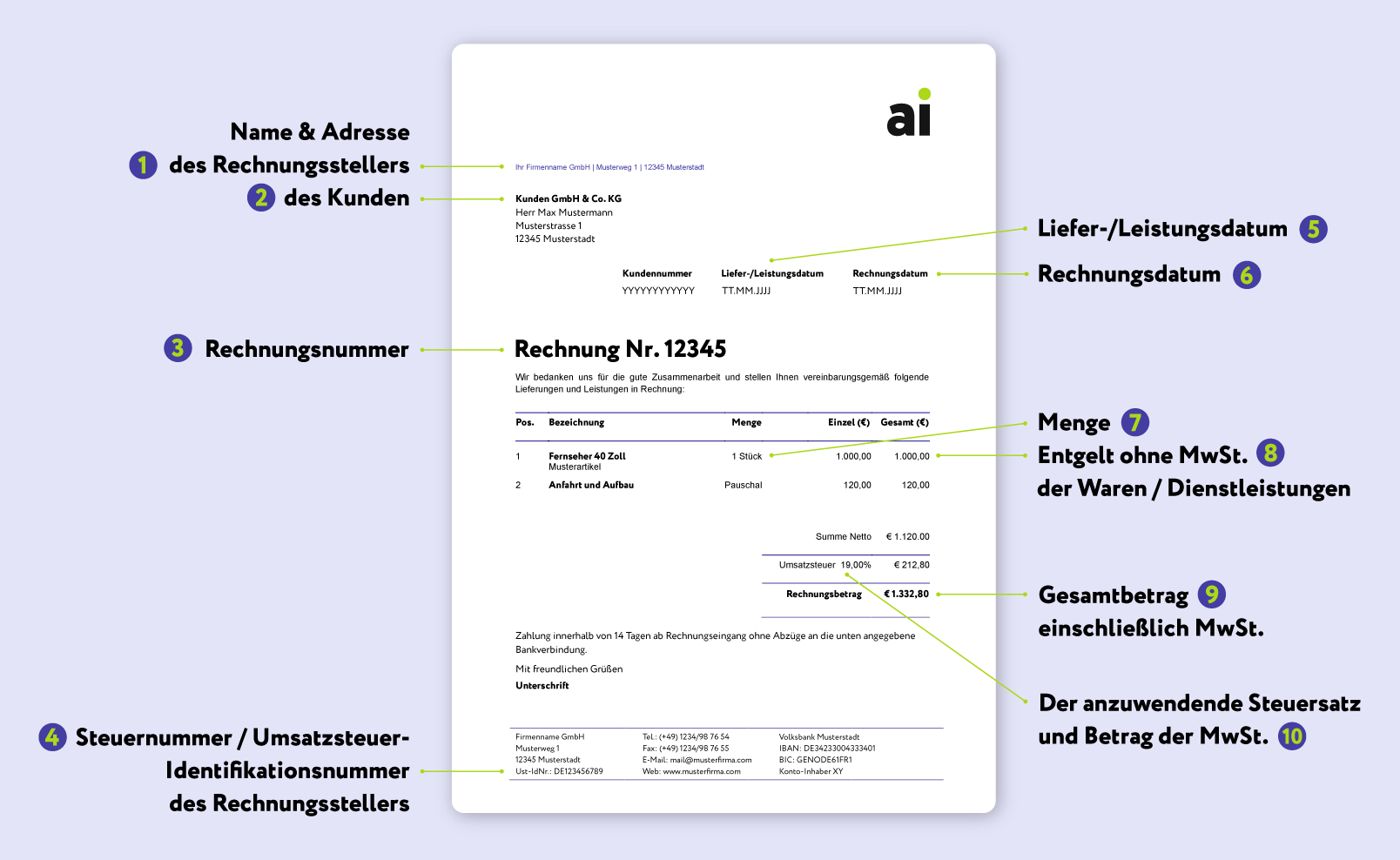
If you, as a seller, want to create an Amazon invoice, it must – depending on the individual case – contain certain mandatory information. For invoices over €250, this generally includes:

  • full name and address of the seller
  • full name and address of the customer
  • tax number or VAT ID number
  • date of issue
  • sequential invoice number
  • quantity and type of goods or services supplied
  • Date of delivery or service
  • Net amount, tax rate, and VAT amount
  • Gross amount

Depending on the sales situation, further information may be necessary, for example, in cases of reverse charge, intra-community supplies, or the small business regulation.

Why correct invoices are so important for Amazon sellers

As an online seller on Amazon, you typically sell not only in Germany but also across Europe and worldwide. The multitude of different customers, varying VAT rates, and complex legal regulations make invoicing a real challenge.

First and foremost, correct invoices provide legal certainty. Every invoice is a legally binding document. It serves as proof of your sales and the VAT you remit to the tax authorities. Error-free invoices are the basis for accurate VAT pre-declarations and an accurate annual financial statement.

For your B2B customers, a proper invoice is essential, as it's the only way they can reclaim the paid VAT as input tax from the tax office. If your invoice contains errors, you risk your customer losing their input tax deduction. This harms your business relationship and your reputation. A professional invoice also signals professionalism and transparency.

What information must be included on an Amazon invoice?

The mandatory legal information – or: What must not be missing from any invoice. These are regulated in Section 14 of the German Value Added Tax Act (UStG) . Accordingly, an invoice must contain certain information, unless it is a small-value invoice (up to €250), for which exceptions apply. For invoices over €250, the following information is mandatory:

  • Your details: Your full name and a legally valid address, as well as your tax number or, for international sales, your VAT identification number (VAT ID).
  • Your customer's details: The recipient's full name and legal address.
  • Invoice details: The date of issue, a sequential and unique invoice number with no gaps, and a clear description of the quantity and type of goods or services supplied.
  • Amounts: The total amount, broken down by applicable tax rates (e.g., 19% or 7%), as well as the exact tax amount. The date of supply or service must also be specified.
💡 Tip for increased legal certainty: Always check the completeness of your own company details and those of your customer before creating an invoice. A quick check of the address and VAT identification numbers helps to avoid errors and queries later on.

In addition to the standard mandatory information, there are specific regulations that apply depending on the nature of your business and your tax situation. These special cases are crucial for the legal accuracy and tax compliance of your invoice.

If you sell goods to another company in an EU member state, this is considered an intra-community supply. In this case, VAT is not due in Germany, but in the recipient's country. To prove the tax exemption of the supply, you must verify the validity of your buyer's VAT identification number (VAT ID) before invoicing . The invoice must include the following mandatory information and details:

  • Your VAT ID as the seller and that of your buyer.
  • The note "Steuerschuldnerschaft des Leistungsempfängers" or the English equivalent "Reverse Charge". This notice transfers the tax liability from the seller to the buyer.

Further reading: Intra-community supplies are just one part of the complex EU tax obligations. As soon as you use Amazon's warehouses abroad (e.g., through PAN-EU), further obligations arise, such as reporting goods movements. Check out our guide: Amazon FBA Tax: PAN-EU & CEE – How to navigate the tax labyrinth safely

In Germany, as an entrepreneur, you can claim the Small Business Regulation according to Section 19 of the Value Added Tax Act (UStG) if your turnover in the previous year did not exceed €22,000 and is not expected to exceed €50,000 in the current year. As a small business owner, you are exempt from VAT. This means you are not allowed to show or charge VAT on your invoices. However, to avoid misunderstandings and comply with legal requirements, each of your invoices must include the note "No VAT is charged according to Section 19 UStG" .

💡Decision aid: The small business regulation is tempting because it eliminates the VAT obligation. However, keep in mind: As a small business owner, you also cannot reclaim input tax from purchases (e.g., for advertising costs or product purchases) from the tax office. Therefore, carefully weigh the pros and cons, ideally in consultation with your tax advisor.

Amazon VCS: What it does – and where it reaches its limits

Amazon offers its sellers, with the Amazon VAT Calculation Service (VCS) offers an integrated solution that automates part of the invoicing process. At first glance, this seems practical, but it's important to understand the crucial limitations.

How Amazon VCS Works

VCS automatically generates invoices for your business customers as soon as an order is shipped. These invoices are provided directly through the Amazon system. This saves time and effort in processing B2B sales.

Crucial Disadvantages and Risks for Sellers

Even though VCS is helpful, it does not shift the responsibility for legal correctness away from you as a seller. There are crucial weaknesses that often make the use of specialized software indispensable:

  • Seller Retains Responsibility: The most important limitation is that Amazon merely provides a tool. As a seller, you remain legally responsible for the correctness of invoices and the proper application of tax rates. Incorrect product tax codes or incomplete customer information can lead to incorrect invoices.
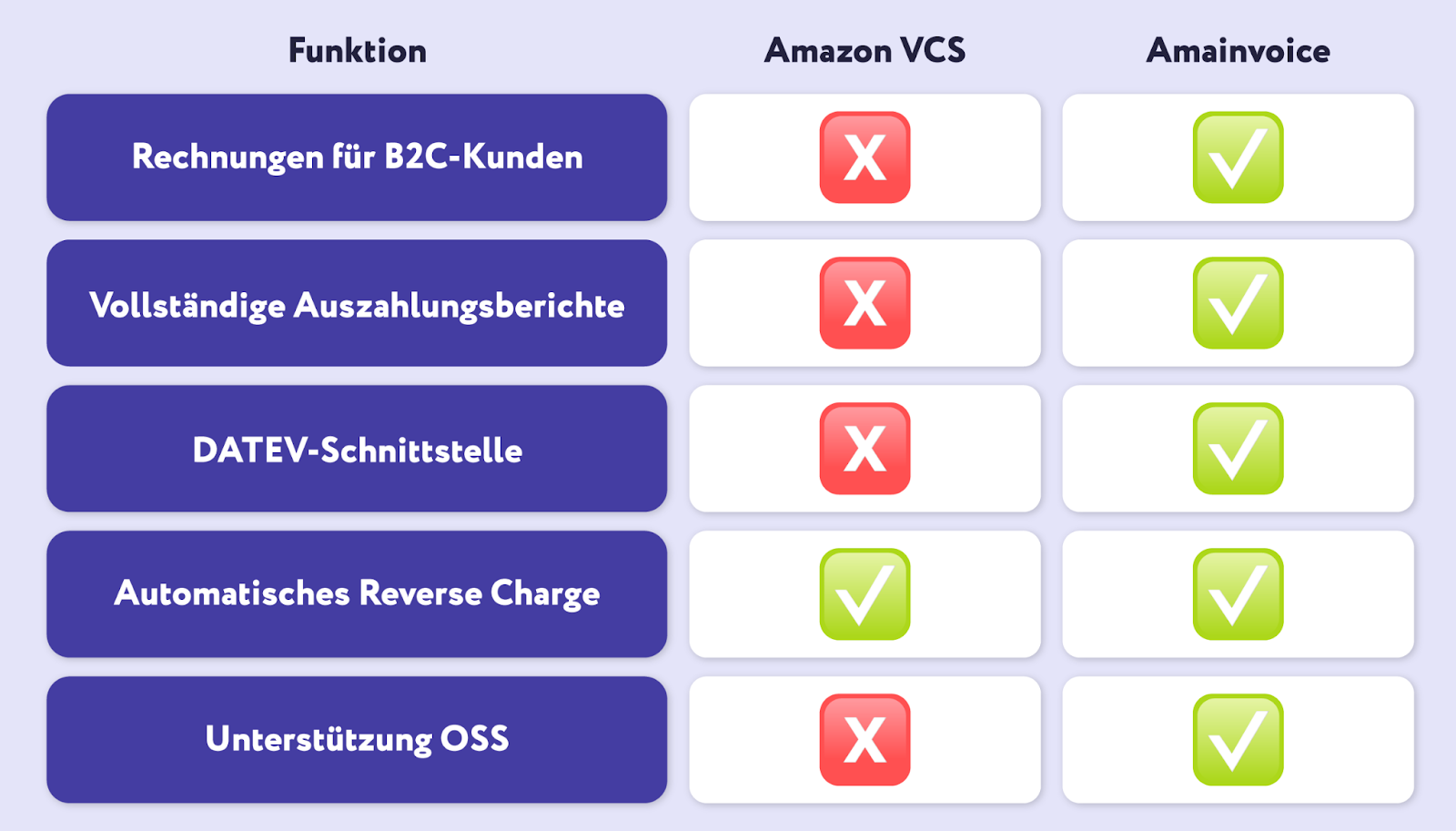
  • No Solution for B2C Customers: VCS only generates invoices for customers who have provided a valid VAT identification number. For private customers (B2C), you still have to handle invoicing yourself.
  • Lack of Transparency and Interfaces: VCS does not provide detailed payout reports that allow for precise reconciliation with your financial accounting. Furthermore, DATEV-compatible data formats are missing, which complicates collaboration with your tax advisor. Without manual data preparation, errors can quickly arise.
  • Limited Functionality in Special Cases: In complex scenarios such as the correct handling of the OSS declaration (One-Stop-Shop) or dealing with returns and credit notes, VCS reaches its limits and often requires manual post-processing.
💡Important Note: Don't blindly rely on Amazon for your accounting. Tools like VCS only automate part of the process. The legal responsibility for your bookkeeping always lies with you as the seller.

Amainvoice: The ideal invoicing software for Amazon sellers

Manually invoicing hundreds or even thousands of orders is simply impossible given the complexity of Amazon's business. This is where Amainvoice comes in: a software specifically developed for the complex requirements of Amazon accounting and precisely fills the gaps left by Amazon VCS.

How Amainvoice solves your accounting problems

Amainvoice was designed to relieve you of all accounting worries and give you the assurance that your invoices and data are always legally compliant.

  • Full Automation & Compliance: Unlike Amazon VCS, Amainvoice generates invoices for both B2B and B2C sales. The software automatically takes into account the correct VAT and country-specific regulations. All invoices are submitted to Amazon in the correct format and made available for download to your customers and you.
  • Seamless Management of Special Cases: The invoicing software automatically recognizes when the reverse-charge procedure or the small business regulation applies, and adjusts the invoice accordingly. The correct creation of the OSS declaration, which is essential for international sales within the EU, is also fully automated.
  • Clear and Detailed Financial Reports: Unlike Amazon's opaque reports, Amainvoice transparently breaks down all disbursement reports. You receive precise overviews of Amazon Fees, refunds, and revenues, which significantly simplifies reconciliation with your financial accounting and strengthens your financial control.
  • Seamless cooperation with your tax advisor: Amainvoice provides all data in a DATEV-compatible format and can transmit the accounting data directly to your Amazon tax advisor. This saves both you and them valuable time and eliminates sources of error from manual data entry.
  • Comprehensive support for all Amazon models: Whether you use FBA (Fulfillment by Amazon), FBM (Fulfillment by Merchant), or the PAN-EU program, Amainvoice is designed for all models and ensures that complex international invoicing and inventory management are correctly handled.
💡For efficient tax filing: Good invoicing software not only provides accurate data but also structures it in such a way that your tax advisor can process it without significant effort.

Conclusion: Why Amainvoice creates the perfect invoice

Creating the perfect Amazon invoice is an accounting feat that is almost impossible without specialized invoicing software . While Amazon VCS takes over some of the work, it quickly reaches its limits when it comes to the crucial aspects of accounting .

Amainvoice offers you the solution you need for a smooth accounting and control process. Through automation, consideration of all special cases, and direct integration with financial accounting, it is ensured that your Invoices are not only legally compliant but also a crucial component for your business success.

Would you like to see how Amainvoice revolutionizes your accounting? Try Amainvoice now, free and without obligation.

Not sure if your current Amazon accounting meets the requirements? Then use our free accounting analysis from Amainvoice for Amazon sellers and get a professional assessment.

Anyone selling on Amazon will eventually have to deal with invoicing. Especially once you, as a seller, process your first orders via Amazon FBA or FBM , the question arises: How to correctly create an Amazon invoice?

The challenge: Amazon invoices must not only be formally complete but also fit the specific tax situation. Different requirements apply depending on whether you sell to private customers or businesses, deliver within Germany, or trade across borders in the EU.

In this post, you will learn:

  • which required information must be included on an Amazon invoice,
  • how you can correctly create Amazon invoices ,
  • what applies to Amazon FBA invoices, B2B cases, Reverse Charge and the small business regulation ,
  • and how Amazon invoices can be automated .

If you want to delve deeper into Amazon accounting, you can also find our article on FBA, FBM, and PAN-EU – which Amazon model suits your business.

How do I create an Amazon invoice?

You generally create an Amazon invoice according to the same legal rules as any other invoice. However, it's crucial to consider the specific characteristics of Amazon trading. These include, among others:

  • different customer types (B2C or B2B),
  • various delivery countries,
  • differing VAT rates,
  • special cases such as intra-community supplies or Reverse Charge,
  • and depending on the business model, requirements related to FBA, FBM or PAN-EU.

Therefore, when you issue invoices for your Amazon sales, you should always clearly answer two questions:

  1. What information is legally required?
  2. What specific tax situation applies to this order?

The second point, in particular, is often underestimated in practice. Because a formally complete invoice is not automatically a tax-compliant Amazon invoice.

What mandatory information must an Amazon invoice contain?

Generally, for invoices over €250, the mandatory information as per § 14 UStGapplies. As a seller, if you wish to issue an Amazon invoice, the following information should typically be included:

  • full name and address of the seller
  • full name and address of the customer
  • tax number or VAT identification number
  • date of issue
  • sequential, unique invoice number
  • quantity and type of goods or services supplied
  • date of delivery or service
  • Net amount
  • applicable tax rate
  • VAT amount
  • Gross amount

For Amazon sellers, it's important to note: These mandatory details are just the basics. Depending on the sales situation, additional information may be required, for example, in the case of intra-community supply, with reverse charge or under the small business regulation.

Why is creating Amazon invoices often more complex than for other shops?

Creating Amazon invoices is often more complex than in traditional e-commerce. The reason lies in the combination of platform logic, international delivery structures, and special tax cases.

Many sellers operate not only within Germany but also across Europe. This becomes particularly relevant if you use models such as Amazon FBA or PAN-EU . Then you not only have to issue invoices correctly but also properly classify the underlying goods movements and tax obligations.

If you want to know the differences between the Amazon models, it's worth taking a look at our guide on FBA, FBM, and PAN-EU. For international warehousing and tax questions, our article on Amazon FBA Tax: PAN-EU & CEE helpful.

What applies to Amazon invoices for B2B customers?

When you sell to a business via Amazon, additional requirements often apply to invoicing. The distinction between domestic sales and cross-border B2B deliveries within the EU is particularly important.

In B2B cases, you should especially check:

  • whether your customer is a business,
  • whether a valid VAT ID is available,
  • which country of delivery is involved,
  • and whether a special note is required on the invoice.

For your accounting and tax classification, it is crucial that the invoice is not only complete but also structured appropriately for the specific B2B case.

If you want to review the topic of VAT ID in detail, you can find our glossary entry here: What is the Value Added Tax Identification Number (VAT ID)?

What applies to Amazon invoices within the EU?

As soon as you sell goods to businesses in other EU member states, you need to check particularly carefully which tax rules apply. In many cases, it involves intra-community supplies and the question of whether the invoice needs to include a note such as “Reverse Charge” or “Reverse Charge” must be included.

It is important to note: Not every Amazon invoice to an EU customer is automatically treated the same way. Key factors include:

  • the customer's registered office,
  • the type of customer (private individual or business entity),
  • the country of delivery,
  • the movement of goods,
  • and the tax classification of the transaction.

For more information, see our detailed articles on intra-Community supply and on Reverse Charge on Amazon.

What does an Amazon invoice look like for Reverse Charge?

When the Reverse Charge procedure applies to a sale, the tax liability is transferred to the recipient of the service. In such cases, the invoice must not be treated like a regular domestic sale.

The Amazon invoice must then generally include a corresponding note, for example:

“Recipient liable for VAT”
or
“Reverse Charge”

Additionally, the tax requirements for the case must be correctly checked. This is particularly important for international Amazon sales, as incorrect invoices can later lead to problems in accounting or during tax audits.

You can find a more detailed explanation here: Reverse Charge on Amazon – what sellers need to know about shifting tax liability

What does an Amazon invoice look like for a small business owner?

If you, as an Amazon seller, use the small business regulation according to § 19 UStG , you are not allowed to show VAT on your invoices. Instead, the invoice should contain a clear note, for example:

"According to § 19 UStG, no VAT is charged."

This is particularly important because an incorrect representation of VAT can quickly lead to misunderstandings, queries, or accounting errors.

Whether the small business regulation makes sense for your business model heavily depends on your revenue, cost structure, and marketplace setup. If you want to delve deeper into this topic, you can find more information here: What is the small business regulation for Amazon sellers?

What do sellers need to consider for Amazon FBA invoices?

When you create Amazon FBA invoices , it's especially important not to just look at the invoice itself, but also the underlying fulfillment model. This is because FBA can be significantly more complex from a tax perspective than a purely national shipping model.

Relevant factors include:

  • storage of goods in different countries,
  • cross-border movement of goods,
  • differing tax classifications,
  • OSS-relevant facts,
  • and correct representation in your accounting.

This is precisely why sellers working with FBA should not view their Amazon invoicing in isolation, but always link it to their overall accounting.

If you want to dive deeper, these articles can help:

Is Amazon itself sufficient for issuing invoices?

Amazon offers with its VAT Calculation Service (VCS) its own feature that supports sellers with invoice generation. This can be helpful for certain processes. Nevertheless, sellers should carefully check what is actually covered by it – and what is not.

The key is to distinguish between two questions:

  • How must an Amazon invoice be structured to be professionally compliant?
  • How is invoice generation technically implemented?

For the first question, the legal and tax responsibility always remains with the seller, even if parts of the process are automated via Amazon or other systems.

How does automatic invoice generation work on Amazon?

Many sellers don't want to manually create their invoices, but rather use processes like Amazon's automatic invoice generation or automatic invoice upload . This is particularly useful when many orders are processed or different tax cases need to be accurately represented.

Automation can help with:

  • generating large quantities of invoices,
  • assigning different tax logics,
  • structured storage of invoice data,
  • and handover to accounting or tax consultancy.

Nevertheless, the following applies: Even an automated Amazon invoice must be factually correct. Automation therefore does not replace the understanding of mandatory information and tax logic, but builds upon it.

If you are particularly interested in collaborating with financial accounting, this article may also be helpful: DATEV & Tax Advisors for Amazon – How to Optimize Collaboration for Your Accounting

How can I automate Amazon invoices?

If you regularly process many Amazon orders, manual invoice creation quickly becomes error-prone and time-consuming. Then the question arises of how to automate Amazon invoices without losing tax correctness.

It is crucial that a solution not only generates invoices but can also handle typical Amazon special cases, such as:

  • B2B and B2C differentiation,
  • different VAT rates,
  • Reverse Charge,
  • OSS-relevant sales,
  • returns, refunds, and credit notes,
  • as well as the structured handover to accounting.

How can I create Amazon invoices with Amainvoice?

With Amainvoice sellers can automatically create and provide Amazon invoices. This is particularly interesting if you process many orders or want to seamlessly integrate invoicing processes with your accounting.

It is important to note: Even if software supports you in creating Amazon invoices, the fundamental principles remain the same. Invoices must be factually correct in their structure and fit the respective tax case.

If you want to check how well your current processes are set up, you can also use a free accounting analysis for Amazon sellers .

What typical mistakes are made when creating Amazon invoices?

In practice, similar errors frequently occur with Amazon invoices. These include, for example:

  • incomplete mandatory information,
  • incorrect tax logic,
  • missing notes for Reverse Charge,
  • incorrect handling of B2B and B2C cases,
  • unclear processes for FBA or EU scenarios,
  • and lack of coordination between invoicing and accounting.

Precisely because Amazon sales are often more complex than traditional shop orders, a structured process is worthwhile. If you want to set up your accounting properly overall, our article on hidden Amazon FBA fees can also be useful, because invoicing logic and fee logic are often considered together in practice.

Conclusion: Correctly Create Amazon Invoices and Set Up Processes Properly

Anyone who sells on Amazon should not treat invoicing as an afterthought. Whether you want to create an Amazon invoice, an Amazon FBA invoice or Automate Amazon Invoices you want: It's always crucial that every invoice is both formally complete and tax-compliant.

For sellers, a two-step approach is therefore advisable:

  1. Understand the specific requirements
    i.e., accurately classify mandatory information, customer types, tax scenarios, and special rules
  2. Implement processes effectively
    i.e., decide whether and how you handle invoicing manually or automatically

If you want to further professionalize your processes, you will find a lot of supplementary content on Amainvoice's knowledge page – for example, on OSS basics, Reverse Charge, PAN-EU & CEE or on collaboration with DATEV and tax advisors.

Amazon Invoice Requirements: The Complete Guide for Sellers

At a Glance

  • Every Amazon invoice must include all legally required details — seller and buyer information, invoice number, delivery date, net amount, tax rate, tax amount, and gross total.
  • Amazon FBA invoices follow the same legal requirements but come with significantly higher tax complexity: cross-border warehouse structures, OSS, PAN-EU, and reverse charge all require correct case-by-case classification.
  • B2B invoices require the customer's VAT ID and, in many cases, a reverse charge notice — a standard domestic template won't cut it.
  • Small business owners (Kleinunternehmer equivalent in their jurisdiction) must not show VAT and must include a specific statutory reference.
  • Sellers processing significant order volumes should automate Amazon invoicing — manual invoicing at scale is error-prone and unsustainable.
  • Amainvoice automates the entire Amazon invoicing process, including correct tax classification (B2B/B2C, reverse charge, OSS, FBA), and delivers structured data to your accounting system.
  • No software — including Amainvoice — replaces a fundamental understanding of the underlying tax requirements.

Why Amazon Invoicing Is More Complex Than It Looks

Selling on Amazon means dealing with a level of invoicing complexity that most e-commerce platforms simply don't generate. Unlike a standard online shop, Amazon introduces a combination of factors that affect every invoice you issue:

  • Multiple customer types (B2C consumers vs. B2B business buyers)
  • Cross-border logistics — particularly with FBA, where your inventory may be stored across multiple EU countries
  • Different VAT regimes — domestic, intra-EU, OSS, and reverse charge all follow different rules
  • Platform-specific processes like VCS (VAT Calculation Service) that cover some scenarios but not all

Sellers who understand these dynamics — and automate their invoicing accordingly — avoid the compliance risks that trip up even experienced merchants.

Amainvoice was built specifically for these scenarios. If you're selling on Amazon at any meaningful scale, read on — and see where automation makes the most sense for your setup.

Mandatory Invoice Information for Amazon Sellers

In the EU, invoice requirements are governed by VAT directives and transposed into national law (e.g. §14 UStG in Germany). For invoices above €250, the following fields are legally required:

  • Full name and address of the seller
  • Full name and address of the buyer
  • Tax number or VAT ID (VAT Identification Number)
  • Invoice date
  • Unique, sequential invoice number
  • Description of goods or services (quantity and type)
  • Date of supply or service delivery
  • Net amount
  • Applicable VAT rate
  • VAT amount
  • Gross total

This is the baseline. For Amazon sellers — especially those selling cross-border or via FBA — additional requirements layer on top depending on the transaction type.

Note: Simplified invoice rules (equivalent to Germany's §33 UStDV) apply for invoices below €250. For sellers doing regular B2B business, this threshold is rarely relevant in practice.

Amazon FBA Invoices: Same Rules, Higher Complexity

Running FBA means your inventory moves across borders before a single sale is made. That creates tax obligations — and invoicing requirements — that don't exist in a simple domestic fulfilment model.

Key challenges for Amazon FBA invoices:

  • Multi-country inventory storage: FBA warehouses across the EU create local VAT registration obligations that affect how invoices must be structured.
  • Cross-border stock transfers: Moving goods between FBA warehouses is a taxable event in many scenarios — and must be reflected correctly in your records.
  • OSS (One Stop Shop): Sellers making B2C sales across EU borders typically need to account for VAT via OSS — which must be correctly mapped in invoice data.
  • PAN-EU and CEE setups: Multi-country fulfilment programs create concurrent tax obligations in several EU states simultaneously.

Amainvoice handles these scenarios automatically — recognising the tax case behind each order and generating the correct invoice output, without requiring manual case-by-case decisions.

→ Related: Amazon FBA Tax: PAN-EU & CEE — Navigating the Tax Maze
→ Related: FBA, FBM and PAN-EU — Which Amazon Model Fits Your Business?

B2B Invoices on Amazon: What Changes

When selling to a business buyer, the invoice requirements shift. Before issuing a B2B invoice, confirm:

  • Is the buyer a registered business? (VAT ID required)
  • Has the VAT ID been verified? (VIES system recommended)
  • Does the reverse charge mechanism apply?
  • Which country's VAT rules govern the transaction?

For cross-border B2B sales within the EU, getting the invoice wording wrong — or missing the reverse charge notice — can create problems during tax audits on both sides of the transaction. It's not just a formality: a missing reverse charge notice can trigger VAT liability for the seller even when the sale was genuinely exempt.

Reverse Charge: How It Affects Your Amazon Invoice

The reverse charge mechanism shifts VAT liability from seller to buyer in cross-border B2B transactions within the EU. When reverse charge applies:

  • No VAT is shown on the invoice. The net amount is the invoice total.
  • A mandatory notice must appear on the invoice, such as:
    "VAT reverse charge – tax liability transferred to the recipient"
  • The buyer accounts for VAT in their own country.

Reverse charge is one of the most common sources of invoicing errors among Amazon sellers — particularly those who apply domestic invoice templates to international B2B sales. At volume, this is exactly the type of case where automated invoice logic pays off.

→ Related: Reverse Charge on Amazon — What Sellers Need to Know
→ Related: Intra-Community Supplies Explained

Automating Amazon Invoices: When Manual Stops Working

Manual invoice creation works — until it doesn't. For sellers processing hundreds or thousands of orders per month, manual invoicing creates compounding risk: missed tax cases, inconsistent formatting, delayed delivery to bookkeeping, and no audit trail.

Automating Amazon invoices isn't just about speed. A proper solution must handle:

  • B2B vs. B2C — different invoice logic, different output
  • Domestic vs. cross-border — correct VAT rate and place of supply
  • Reverse charge — no VAT shown, mandatory notice included
  • OSS-relevant transactions — correct per-country allocation
  • Returns, refunds, and credit notes — their own invoice type and logic
  • Structured handoff to accounting software or your accountant (DATEV, etc.)

Amainvoice connects directly to your Amazon account, reads order data, identifies the applicable tax case, and generates the correct invoice — at scale, without manual intervention. Output is structured for direct use in DATEV or by your accountant.

→ Pricing: Amainvoice Plans & Pricing
→ Free analysis: Amazon Accounting Health Check

Amazon VCS vs. Specialised Invoicing Software

Amazon's VAT Calculation Service (VCS) provides a built-in invoicing option. For simple, domestic setups, it can be a starting point. But VCS has clear limitations:

  • Limited handling of complex cross-border tax scenarios
  • No structured DATEV-compatible export
  • No accountant access or multi-client functionality
  • Minimal configurability for edge cases (reverse charge, OSS, FBA)

For sellers who need reliable, scalable, and audit-ready invoicing, Amainvoice fills the gap. It's purpose-built for Amazon commerce — not a generic invoicing tool with an Amazon plugin.

Common Amazon Invoicing Mistakes — and Why They Happen

These errors appear consistently across Amazon sellers of all sizes:

  • Missing mandatory fields — no invoice number, missing supply date
  • Wrong tax logic — applying 20% VAT to a reverse charge transaction
  • Missing reverse charge notice — legally required, often forgotten
  • VAT shown on a VAT-exempt invoice — creates a tax liability that didn't otherwise exist
  • No B2B/B2C distinction — same template applied regardless of buyer type
  • FBA tax case unrecognised — wrong country of supply, wrong VAT treatment
  • No structured accounting handoff — invoices exist but don't feed bookkeeping correctly

Most of these mistakes stem not from carelessness but from underestimating how much the Amazon selling model differs from standard retail. A structured, automated process eliminates the majority of these risks at the source.

Conclusion: Get the Basics Right, Then Scale Them

Invoicing on Amazon isn't a set-and-forget task. What works manually at low volume becomes a compliance liability as your business grows. The right approach is two-stage:

  1. Understand the requirements — which fields are mandatory, which tax case applies, what notices are required in which scenario.
  2. Automate correctly — with a solution built for Amazon's specific complexity, not a generic tool.

Amainvoice handles stage two without cutting corners on stage one. You stay in control of the logic; the software handles the volume.

Start your free trial
Request a free accounting analysis
View pricing

FAQ: Amazon Invoicing for Sellers

Do I have to issue invoices for every Amazon sale?
B2B buyers are legally entitled to request a VAT invoice, and you're obliged to provide one. For B2C sales, requirements vary by country, but consistent invoicing is strongly recommended for your own accounting records regardless of customer requests.

What information must appear on an Amazon FBA invoice?
The same mandatory fields as any VAT invoice under EU law — seller and buyer details, invoice number, supply date, net amount, VAT rate, VAT amount, and gross total. FBA adds complexity through multi-country logistics and OSS obligations, which affect how individual transactions must be classified and documented.

Can I automate Amazon invoice creation?
Yes. Amazon's VCS handles basic scenarios. For FBA, PAN-EU, B2B sales, and DATEV-compatible accounting handoff, specialised software like Amainvoice is the more reliable option. Automation doesn't remove the requirement for correct logic — it executes correct logic at scale.

What happens if an Amazon invoice is incorrect?
Errors can result in VAT assessments, loss of the buyer's input tax deduction rights, and problems during tax audits. Under §14c UStG (Germany) and equivalent EU provisions, incorrectly shown VAT becomes payable by the issuer — even if the sale itself was VAT-exempt.

What's the difference between a B2B and B2C Amazon invoice?
For B2C cross-border sales within the EU, VAT is charged at the buyer's country rate (via OSS). For B2B intra-EU sales, reverse charge typically applies — no VAT shown on the invoice, mandatory notice required. The exact treatment depends on the specific transaction and the VAT registration situation in each country.

How does Amainvoice handle Amazon invoicing?
Amainvoice connects to your Amazon Seller account, pulls order data, classifies each transaction by tax type, and generates the correct invoice automatically. Output is structured for DATEV or direct use by your accountant. More at amainvoice.de/solutions/amazon-rechnungen.

Does the VAT small business exemption apply to international Amazon sales?
Generally yes, but with important caveats. Once certain distance selling thresholds are exceeded, or if FBA warehouses are used in other EU countries, the exemption may not apply in those jurisdictions. Advice from an Amazon-specialised tax advisor is strongly recommended before assuming the exemption covers all your sales.

This article is for general informational purposes only and does not constitute tax or legal advice. Please consult a qualified tax advisor for guidance specific to your situation.

This is some text inside of a div block.

Get Started With Amainvoice Today

Häufig gestellte Fragen rund um Amazon Rechnungen

Ja – sobald ein Käufer eine Rechnung anfordert (insbesondere B2B-Kunden), bist du gesetzlich zur Ausstellung verpflichtet. Auch ohne Aufforderung empfiehlt sich eine konsistente Rechnungsstellung für deine eigene Buchhaltung.

Ja. Amazon bietet den VAT Calculation Service (VCS) an, der für einfache Fälle hilfreich ist. Für komplexere Setups – FBA, PAN-EU, B2B, DATEV-Übergabe – empfiehlt sich eine spezialisierte Lösung wie Amainvoice.

Bei B2C-Rechnungen richtet sich der Steuersatz nach dem Lieferland des Kunden (OSS). Bei B2B-Rechnungen innerhalb der EU gilt in vielen Fällen das Reverse-Charge-Verfahren – ohne USt-Ausweis, dafür mit Pflichthinweis. Die genaue Einordnung hängt vom Einzelfall ab.

Grundsätzlich ja – allerdings mit Einschränkungen. Sobald bestimmte Lieferschwellen überschritten werden oder Besonderheiten wie FBA-Lager im Ausland vorliegen, kann die Kleinunternehmerregelung an ihre Grenzen stoßen. Eine Beratung durch einen Amazon-spezialisierten Steuerberater ist hier dringend empfohlen.

Dieselben Pflichtangaben wie bei jeder anderen Rechnung nach § 14 UStG – jedoch mit zusätzlicher steuerlicher Einordnung je nach Liefer- und Lagerland, Kundentyp (B2B/B2C) und Verfahren (OSS, Reverse Charge, PAN-EU).

Fehlende oder falsche Angaben können steuerliche Nachforderungen auslösen, die Vorsteuerabzugsberechtigung des Kunden gefährden und bei Betriebsprüfungen zu Problemen führen. Im schlimmsten Fall schuldet der Aussteller ausgewiesene Steuer auch dann, wenn sie sachlich nicht anfiel (§ 14c UStG).

Amainvoice verbindet sich mit deinem Amazon-Account, liest Bestelldaten aus, ordnet den jeweiligen Steuerfall zu und erstellt darauf basierend korrekte Rechnungen – vollautomatisch. Die Daten werden strukturiert für DATEV oder deinen Steuerberater aufbereitet. Mehr dazu auf amainvoice.de/solutions/amazon-rechnungen.